Understanding Your Fans and Followers
For any conversation to be a success, you need some understanding of the people taking part. In social media, the majority of conversation will be driven by a group of fans who are more engaged than others.
There’s always a group of individuals who tend to post, comment, question, and share more than the rest. Whether it’s on Facebook, Twitter, Google+, these fans are valuable and important for the health of your conversations and your brand’s community.
So what is it about these highly engaged fans you need to understand? The common factor for this group is that they all like to contribute. Look a bit deeper and you’ll realize that they respond and interact in different ways, depending on the context and their own social motivations. It’s these motivations, rather than demographics, that are the real story.
Since social motivations are complex and can overlap we will look at seven behavioral characteristics typical of the most engaged fans. Use these seven dimensions to guide interactions with your most valuable fans, and you’ll have richer conversations that will be more rewarding for all involved.

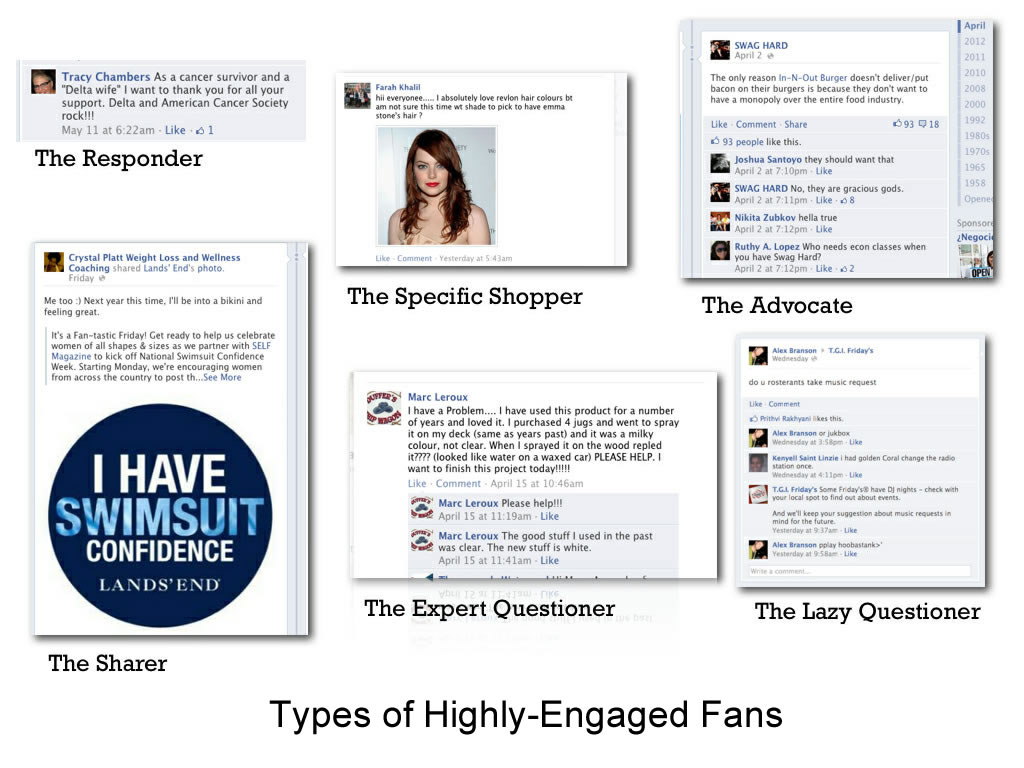
The Responder – Count on these fans to answer a question, enter a competition, like your posts and generally follow your direction. These fans may need prompting but they will be there for you on a rainy day and will keep your overall levels of engagement up. Create regular opportunities for these fans to participate with straightforward instructions and thank them when they do so.
The Sharer – Extending the reach of your conversations, these fans love to redistribute social content to their networks. Think of Sharers as part of your social distribution network. It’s important to make it easy for them to do what they do best: retweet, reblog, repost or sometimes remix.
They may have a sizable or influential network of their own, so make an effort to understand the secondary audience, and consider providing them with exclusive content. If appropriate, look for ways to reward Sharers by involving them in the creation or curation process. Monitor what they share and how they share it to learn what works best. Beware that negative content can be shared just as easily.
The Expert Questioner – These fans like to demonstrate how much they already know by asking questions. They might be asking obscure technical questions, or how a specific component compares to the special edition model from two years ago. What they really want is a chance to show off their encyclopedic knowledge of your product line. Encourage these fans to help answer other questions from the less informed. Or go further and reward them by inviting them to visit your company or letting them come to a special event. Their deep expertise could help craft subtle improvements in your products.
The Lazy Questioner – In some ways the opposite of the Expert Questioner, these fans ask the most basic (and sometimes irrelevant) questions, whilst making no effort to discover the answer. The Lazy Questioner hasn’t bothered to take a few seconds to do a Google search, let alone visit your website or read previous comments. They love your product or brand but they also love it when you serve the answers up to them. Demonstrate great customer service and create links to your product info that will be visible to others by answering them promptly. It’s also an opportunity to defer to the knowledge of your Experts, who will relish the status you have bestowed on them.
The Specific Shopper – Another type of Questioner, these fans want to get involved in a conversation about specifics. Does it come in another shade of blue? Can it be gift-wrapped and shipped to Australia? What accessories are compatible? These actively engaged people want to know the detail, either to get a product or service that’s just right for them, or because they are investing a lot of emotional energy in your brand. They may have deep knowledge of your category, or be a novice, so try to find out their level of expertise if you can. Then show the community how much you care about your fans by giving them the detail they need. They may buy one for themselves as well as their friend in Australia.
 The Advocate – Over time and with the right treatment, the fans above may evolve into the most important members of your community. Advocates may talk about you unprompted, upload photos of themselves with your products, or privately give you feedback about that time you could have done better. They may be so engaged in the conversation they invite their friends to join in, and will share your excitement when you launch something new or have exciting news. They may also appear out of nowhere to defend you against criticism – especially valuable in times of crisis. The ultimate advocates generate positive conversation by encouraging others to try your products or services.
The Critics
Finally, remember that some of the most engaged people may be your critics, which is not necessarily a bad thing. These ‘Constant Critics’ may well be using your products and services already, and can offer valuable insight into where the pain points for certain types of customer are located. By listening carefully and treating them with respect, you may turn your critics into Advocates.