Categories
Customer Relations Marketing Public Relations

Gaming The System (Don’t Do It!)

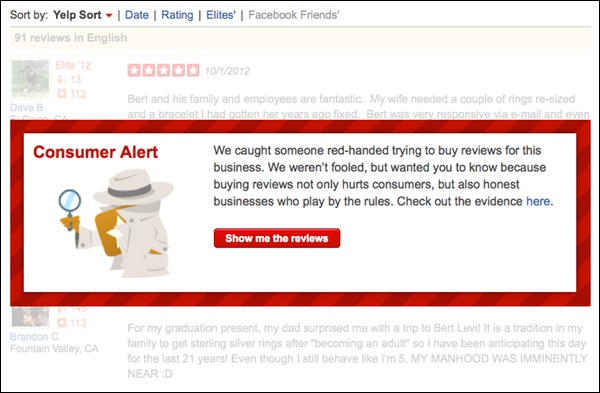
A little while ago Yelp announced that they are now showing “Consumer Alert” warning messages on the profile pages businesses that it says it caught trying to buy reviews.

As the New York Times reported back in October, Yelp conducted a sting operation in which one of its employees pretended to be an “Elite” reviewer and responded to review solicitations on Craigslist. As the article explains:

A pest control company offered $5 to anyone who would post a review that the business itself had written. The moving company was willing to pay $50 but wanted original copy. An appliance repair shop provided a start: “I really appreciate that the service tech was on time, the problem was solved, everything was cleaned up and he was very professional. Please add 50 or more words,” the shop suggested. It would pay $30.

The highest payment was offered by a jewelry store in San Diego, which said they was forced to solicit reviews after others got away with doing it. “We have noticed that some of our larger, corporate run competitors have been unfairly trying to get reviews written for them on Yelp, which puts us at a disadvantage,” wrote Bert Levi of Levi Family Jewelers. He said he would pay $200 for a review of a new custom-designed ring.

This warning is now showing — and will remain for three months — on the Levi Family Jewelers profile page on Yelp, and on the pages of other businesses that Yelp says it caught trying to buy reviews:
Unfortunately this is a result of how competitive the reviews space is right now and how desperate business owners are to get positive reviews. The problem is perhaps worse on Yelp due its review filter, which can be very hit and miss when it comes to choosing reviews to show or hide. This is certainly not a problem that only Yelp faces, as business owners can buy reviews for Google+, Amazon, app stores from various sites often for very little money.

Eric Singley, Yelp’s VP of Consumer and Mobile Products, tells the Times that the group of eight businesses that were outed in October “is just a sample” of businesses that are soliciting reviews. Hopefully Yelp and other review sites can continue to improve their algorithms to so to filter out the fake reviews and prevent the gaming of the reviews.

Here’s a tip on how to get customers to leave reviews on your Yelp or Google+ pages.



Categories
Customer Relations Public Relations Social Media

PR Nightmare


A company’s image is one of the most valuable assets that they own.  Should anything happen to that image, companies can quickly discover that everything they have worked hard to achieve over the years evaporates in front of their eyes in a matter of days.

In this day of Email, Facebook, and Twitter, bad customer service can quickly spread throughout networks.  Take the example of Papa Johns, a well known chain of pizza restaurants.   During the first week of January, a customer named Minhee Cho was described on her receipt by an ethnic slur. She posted the image of the receipt to her Twitter page on Friday, by Sunday it had over 200,000 views.

On Saturday, Papa Johns issued an apology via their Facebook page.  To put into context the scale of bad publicity, there were over 4,500 mentions on their Twitter handle (@PapaJohns) on Saturday verses their normal 50-80 a day).  Their fast response and quick termination of the employee who was responsible for the slur should help minimize the damage, yet even a few weeks later, the incident still showed up on the first page of Google’s search results.

Another recent case of a PR disaster is the case of the N-Control, an after-market controller for the Sony Playstation 3.  The email conversation between the customer inquiring about the status of a controller that he had purchased a month earlier and the third party marketing contractor is jaw-dropping.  In this case, the disaster nearly destroyed the company before it got its brand new product out.

This goes to show how no matter how much you put into your product and the marketing, if you’re not backing it up with trained employees and outstanding customer service, it can all be for nothing.  If a customer has a bad experience, they are likely to tell 9 people over the course of a day.  In this age of social media, mobile apps, texting, etc., a post of their bad experience online can be seen by thousands in minutes.  That’s the power of the internet.

So how does a small company prevent this?  Whether you do everything in house, or hire a company/outside consultant, make sure there are clear guidelines and escalation channels.  Create an atmosphere where if there was a confrontation/mis-understanding/mistake that it can be brought to the attention to decision-makers and quickly resolved.  Ignoring the problem won’t help, it’s best to tackle it.

Also it is important that you have channels to get your message out.  Make use of your email lists, social media, and your website.  Keep an eye on your online presence.  Check in on review sites (Yelp, Angies List, Google Places, etc) , respond to criticisms in a responsible way.  Remember, it just takes one customer with a bad experience to cancel out hundreds of customers with good experiences.