Categories
Customer Relations Email Marketing Marketing

Increasing Email Marketing Open Rates Without Much Work

Email
Email marketing can be a crucial tool for small businesses but it can be tough to see the results that you want.  No marketing campaign will have an open rate of 100%, however it also doesn’t mean that you should settle for single digit views for your campaign.

Categories
Customer Relations Marketing Public Relations

Gaming The System (Don’t Do It!)

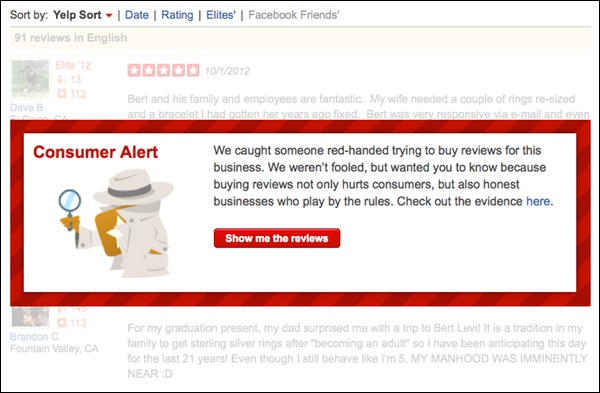
A little while ago Yelp announced that they are now showing “Consumer Alert” warning messages on the profile pages businesses that it says it caught trying to buy reviews.

As the New York Times reported back in October, Yelp conducted a sting operation in which one of its employees pretended to be an “Elite” reviewer and responded to review solicitations on Craigslist. As the article explains:

A pest control company offered $5 to anyone who would post a review that the business itself had written. The moving company was willing to pay $50 but wanted original copy. An appliance repair shop provided a start: “I really appreciate that the service tech was on time, the problem was solved, everything was cleaned up and he was very professional. Please add 50 or more words,” the shop suggested. It would pay $30.

The highest payment was offered by a jewelry store in San Diego, which said they was forced to solicit reviews after others got away with doing it. “We have noticed that some of our larger, corporate run competitors have been unfairly trying to get reviews written for them on Yelp, which puts us at a disadvantage,” wrote Bert Levi of Levi Family Jewelers. He said he would pay $200 for a review of a new custom-designed ring.

This warning is now showing — and will remain for three months — on the Levi Family Jewelers profile page on Yelp, and on the pages of other businesses that Yelp says it caught trying to buy reviews:

Unfortunately this is a result of how competitive the reviews space is right now and how desperate business owners are to get positive reviews. The problem is perhaps worse on Yelp due its review filter, which can be very hit and miss when it comes to choosing reviews to show or hide. This is certainly not a problem that only Yelp faces, as business owners can buy reviews for Google+, Amazon, app stores from various sites often for very little money.

Eric Singley, Yelp’s VP of Consumer and Mobile Products, tells the Times that the group of eight businesses that were outed in October “is just a sample” of businesses that are soliciting reviews. Hopefully Yelp and other review sites can continue to improve their algorithms to so to filter out the fake reviews and prevent the gaming of the reviews.

Here’s a tip on how to get customers to leave reviews on your Yelp or Google+ pages.


Categories
Customer Relations Marketing Social Media

Understanding Your Fans and Followers


Understanding Your Fans and Followers

For any conversation to be a success, you need some understanding of the people taking part. In social media, the majority of conversation will be driven by a group of fans who are more engaged than others.

There’s always a group of individuals who tend to post, comment, question, and share more than the rest. Whether it’s on Facebook, Twitter, Google+, these fans are valuable and important for the health of your conversations and your brand’s community.

So what is it about these highly engaged fans you need to understand? The common factor for this group is that they all like to contribute. Look a bit deeper and you’ll realize that they respond and interact in different ways, depending on the context and their own social motivations. It’s these motivations, rather than demographics, that are the real story.

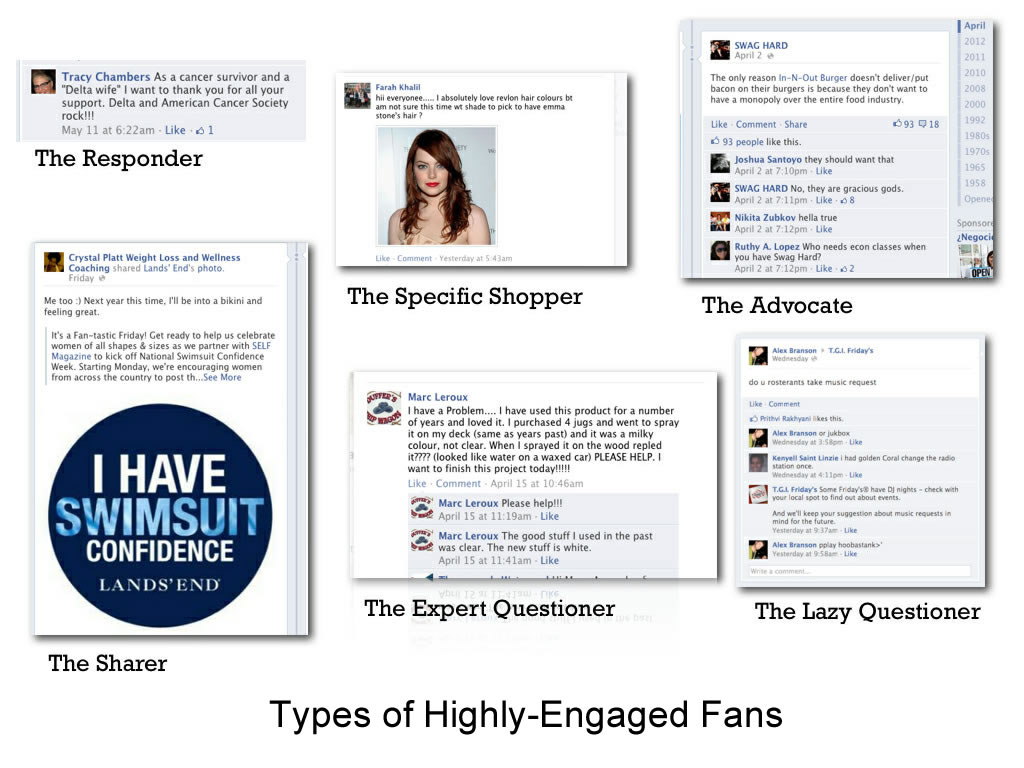
Since social motivations are complex and can overlap we will look at seven behavioral characteristics typical of the most engaged fans.  Use these seven dimensions to guide interactions with your most valuable fans, and you’ll have richer conversations that will be more rewarding for all involved.
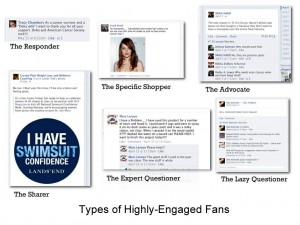
The Responder – Count on these fans to answer a question, enter a competition, like your posts and generally follow your direction. These fans may need prompting but they will be there for you on a rainy day and will keep your overall levels of engagement up. Create regular opportunities for these fans to participate with straightforward instructions and thank them when they do so.


The Sharer
 – Extending the reach of your conversations, these fans love to redistribute social content to their networks. Think of Sharers as part of your social distribution network. It’s important to make it easy for them to do what they do best: retweet, reblog, repost or sometimes remix.

They may have a sizable or influential network of their own, so make an effort to understand the secondary audience, and consider providing them with exclusive content. If appropriate, look for ways to reward Sharers by involving them in the creation or curation process. Monitor what they share and how they share it to learn what works best. Beware that negative content can be shared just as easily.

The Expert Questioner  These fans like to demonstrate how much they already know by asking questions. They might be asking obscure technical questions, or how a specific component compares to the special edition model from two years ago. What they really want is a chance to show off their encyclopedic knowledge of your product line. Encourage these fans to help answer other questions from the less informed. Or go further and reward them by inviting them to visit your company or letting them come to a special event. Their deep expertise could help craft subtle improvements in your products.

The Lazy Questioner – In some ways the opposite of the Expert Questioner, these fans ask the most basic (and sometimes irrelevant) questions, whilst making no effort to discover the answer. The Lazy Questioner hasn’t bothered to take a few seconds to do a Google search, let alone visit your website or read previous comments. They love your product or brand but they also love it when you serve the answers up to them. Demonstrate great customer service and create links to your product info that will be visible to others by answering them promptly. It’s also an opportunity to defer to the knowledge of your Experts, who will relish the status you have bestowed on them.

The Specific Shopper – Another type of Questioner, these fans want to get involved in a conversation about specifics. Does it come in another shade of blue? Can it be gift-wrapped and shipped to Australia? What accessories are compatible? These actively engaged people want to know the detail, either to get a product or service that’s just right for them, or because they are investing a lot of emotional energy in your brand. They may have deep knowledge of your category, or be a novice, so try to find out their level of expertise if you can. Then show the community how much you care about your fans by giving them the detail they need. They may buy one for themselves as well as their friend in Australia.
 

The Advocate – Over time and with the right treatment, the fans above may evolve into the most important members of your community. Advocates may talk about you unprompted, upload photos of themselves with your products, or privately give you feedback about that time you could have done better. They may be so engaged in the conversation they invite their friends to join in, and will share your excitement when you launch something new or have exciting news. They may also appear out of nowhere to defend you against criticism – especially valuable in times of crisis. The ultimate advocates generate positive conversation by encouraging others to try your products or services.

The Critics

Finally, remember that some of the most engaged people may be your critics, which is not necessarily a bad thing. These ‘Constant Critics’ may well be using your products and services already, and can offer valuable insight into where the pain points for certain types of customer are located. By listening carefully and treating them with respect, you may turn your critics into Advocates.

Categories
Branding Marketing

Telling Your Story

What is the best way to tell a story about your business?  In today’s world there are many methods for getting your message out, but how do you tie it all together?

In the below ad by Google, you can see their ecosystem is truly built to help businesses from soup to nuts. Even with Google+ being a question mark, it’s hard to see a business thinking that they should only invest in posting status updates on Facebook or Twitter.

Too often companies miss great opportunities to create excitement for products and services by not taking full advantage of the web.  This doesn’t mean that a company should be sending out loads of twitter messages and doing weekly Google+ Hangouts.

For example, take a bike shop.  Maybe you have a long time customer who just got that dream bike. Take a photo of them just getting the bike and include it in your next newsletter (or post it on your Google Places/Bing Local page).  By highlighting both the long time bond with the customer and the quality of the product you sell you will be creating a story about your company and what it means to be a customer at your store.

Telling the story about your business doesn’t need to be time consuming, but by taking a little time every now and again, you can gain that edge over your competition.  So how do you tell your story?

Categories
Customer Relations Email Marketing Marketing

Timing Your Email Campaign

Reaching customers at the right time of the day can be the difference between getting your emails clicked and having them ignored. The only way to determining the optimal time to send to your customers is to test your campaigns.

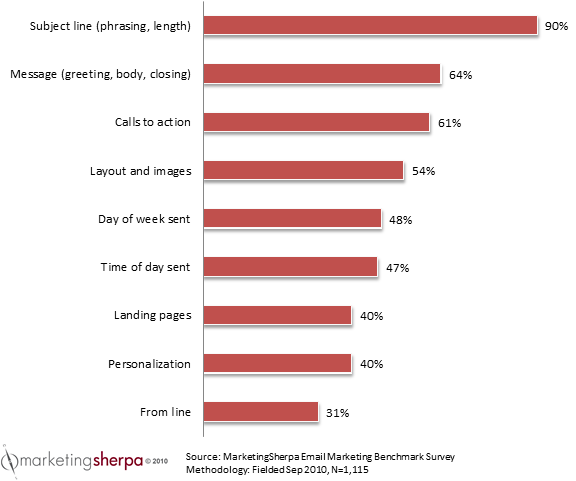
Email Campaign Elements Routinely Tested to Optimize Performance According to research from MarketingSherpa, if just 47% of marketers test when to send an email to their in-house lists, that means over half of all email campaigns are not considering if their emails might be opened, links clicked or better conversion rate by changing the time or day of the week it is sent.

Many companies use the commonly accepted time of 11 am Eastern Standard Time to send emails.  This is probably not ideal if you’re trying to generate leads, simply because many other email campaigns are also targeting this timeslot, cluttering the inboxes of the targeted recipients. The only way to know when is the best time of day to send your emails is to do some testing of your own.

Since every target audience is unique, optimizing your email strategy depends on the understanding the behaviors of your specific audience.  In your testing, consider trying out times you wouldn’t think are optimal for emails.  Record the data that you gain to build a record of your results. While finding the best time to send your email is an important part of delivering a successful email campaign, you will also want to test subject line, message, images, and layouts to maximize your results.  When you find a time that increases email open rate, link click through, or conversions, make sure to still occasionally test the timing.  Your email list changes over time so it is important to keep searching for the optimal time to reach your customers.
Categories
Marketing Mobile

Small Business and Mobile Marketing

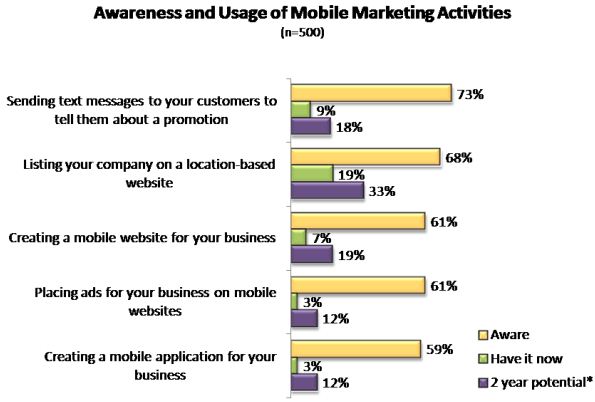
How important is mobile to your small business? Network Solutions did a survey and found that while most SMB’s are aware of the possibilities, few of them are actually using mobile for marketing.


The first line item is a tricky one. Text messaging can be seen as an invasion of privacy for some mobile users, so this probably isn’t the best place to start.

Listing your company with a location-based website, however, is a quick (and most effective) way to get a mobile boost. Setting up an engaging profile with Foursquare, Google Places and Facebook Places is a good way to start (see our previous post on setting up a Places page). This is an easy one and should be way higher than 19%.

Placing ads, creating an app and making your site mobile are all a little more involved both from a time and money standpoint, so it’s easy to see why the actual usage numbers are so low. Still, if you’re in a business that gets foot traffic, you’re missing out if you don’t have a mobile plan.

Another point to consider is making your inventory or portfolio easily seen via the customer’s phone.  Potential customers might not always feel like walking into your store, have the time, or are walking by after hours.  Not engaging these types of customers is a quick way to lose out on potential sales.

Here are the stats from Network Solutions.

One in three searches on mobile is local. After searching for a business: 61% call the business, 59% visit the business; 88% take action the same day.

Jumping into mobile marketing sounds easier than it is, I get that. Most small business owners are already stretched thin just keeping up with the day-to-day. But the numbers on mobile just keep rising, so at some point, you’re going to have to take the plunge or get left behind. For the future of your business, make it sooner than later.

-Patrick

Categories
Branding Marketing Video Marketing

The Long Ad?

I recently went to a  Banff Film Festival that was visiting near my home town.  Prior to watching the film they showed 1-2 minute ads that tied into the spirit of the film festival.  While no one likes to sit through loads of advertisements prior to a film, most of these were enjoyable to watch.  Could this be the start of a new trend?  Conventional wisdom says that advertisements need to be 15 seconds, but to accomplish this advertisers push annoying content at you.  I’m sure by now you have perfected closing down unwanted video advertisements that appear when you load a website.  Recently TED pushed back against this belief and has added interesting advertisements after their media.  Often the videos are ones that you will stick around and enjoy watching and maybe even share them.

It takes a lot for me to visit a website after watching a video.  This clip was the one of the few that spurred me to visit their site.

Dulux Walls from Jodie Sibson Potts on Vimeo.


This one has a great ending.


Nokia ‘Dot’ from Wieden + Kennedy London on Vimeo.

So take a few minutes and watch rest of them, and try not to be moved.

-Patrick

Categories
Marketing SEO

Google’s Dirty Little Secrets

In talking to a client today, the conversation turned to the recent article in the NYTimes on J.C Penney’s.  In the months leading up to Christmas 2010, J.C Penney’s shot up to the top of the Google rankings for various terms which were surprising to see Penney’s holding the number one rank.

The company bested millions of sites — and not just in searches for dresses, bedding and area rugs. For months, it was consistently at or near the top in searches for “skinny jeans,” “home decor,” “comforter sets,” “furniture” and dozens of other words and phrases, from the blandly generic (“tablecloths”) to the strangely specific (“grommet top curtains”).

With more than 1,100 stores and $17.8 billion in total revenue in 2010, Penney is certainly a major player in American retailing. But Google’s stated goal is to sift through every corner of the Internet and find the most important, relevant Web sites.

Does the collective wisdom of the Web really say that Penney has the most essential site when it comes to dresses? And bedding? And area rugs? And dozens of other words and phrases?

How did this happen?  They purchased spammy links which are placed on various websites and these links are then pointed to J.C Penney’s website.  This is a BIG Google no-no.  This is essentially cheating in the online world and it’s called “black hat” optimization.  While it took several months for them to be caught, the long term benefits of this strategy will not help the department store.

On Wednesday evening, Google began what it calls a “manual action” against Penney, essentially demotions specifically aimed at the company.

At 7 p.m. Eastern time on Wednesday, J. C. Penney was still the No. 1 result for “Samsonite carry on luggage.”

Two hours later, it was at No. 71.

At 7 p.m. on Wednesday, Penney was No. 1 in searches for “living room furniture.”

By 9 p.m., it had sunk to No. 68.

In other words, one moment Penney was the most visible online destination for living room furniture in the country.

The next it was essentially buried.

So while there are ways to get yourself to the top ranking quickly, Google will catch you, and the punishment will be painful!  It’s nice to see that Google catches and punishes the cheaters, so all of us who are being honest aren’t penalized.  Check out the full article here.

-Patrick


Categories
Marketing

Local Search


When setting up an account on Google Places, Yahoo! Local, Bing Local, or any of the other similar pages, keep in mind that there is no way to transfer the accounts to someone else.  Should you sell the business or have any other reason to want to transfer control of the account to another person, you will need to shut down the listing and and they will have to create a new one.  This means losing all of your reviews and other information which can be a huge loss if you have built up a good reputation with your customers.

Two things to remember:

  • Don’t create the listing with your personal account.  (i.e using your personal Gmail account for Google Places)  Create a new account which can be transferred.
  • Don’t let a Consultant or Agency create one for you.  The account needs to be independent of their accounts since they won’t be able to transfer it back to you should you want to make changes to your listing.

If you own multiple companies, create multiple accounts to service each of the companies.  While this is more work, it will make things much easier in the long run.

-Patrick

Categories
Customer Relations Marketing Social Media

Playing the Ratings and Review Game

So you’re a small business owner and you know you have a great product or service, but when you look at sites that review your work, you notice that you don’t have many ratings.

Since businesses need to participate in the ratings and review game you need to find ways to get your customers involved in creating authentic reviews.

Let’s say you’re a small coffee shop that hosts a wireless hotspot.  One innovative way to get customers to review your shop is when the customers log in to the hotspot, they go to your home page which has information about menu items and happenings at the shop.  The home page should also have a prominent image that invites the customer (and links them to a site) to write a review. By focusing on a specific review site like Yelp, you should see an increase in ratings.  This will in turn boost your rankings on the site, gaining you more visibility!

For other types of stores or restaurants, maybe you want to create a small business card (or mini menu/event list) especially tailored for reminding people to go to a specific website and leave a comment.

What are you doing to keep reviews top of mind for your customers?

-Patrick