Categories
Customer Relations Email Marketing Marketing

Increasing Email Marketing Open Rates Without Much Work

Email
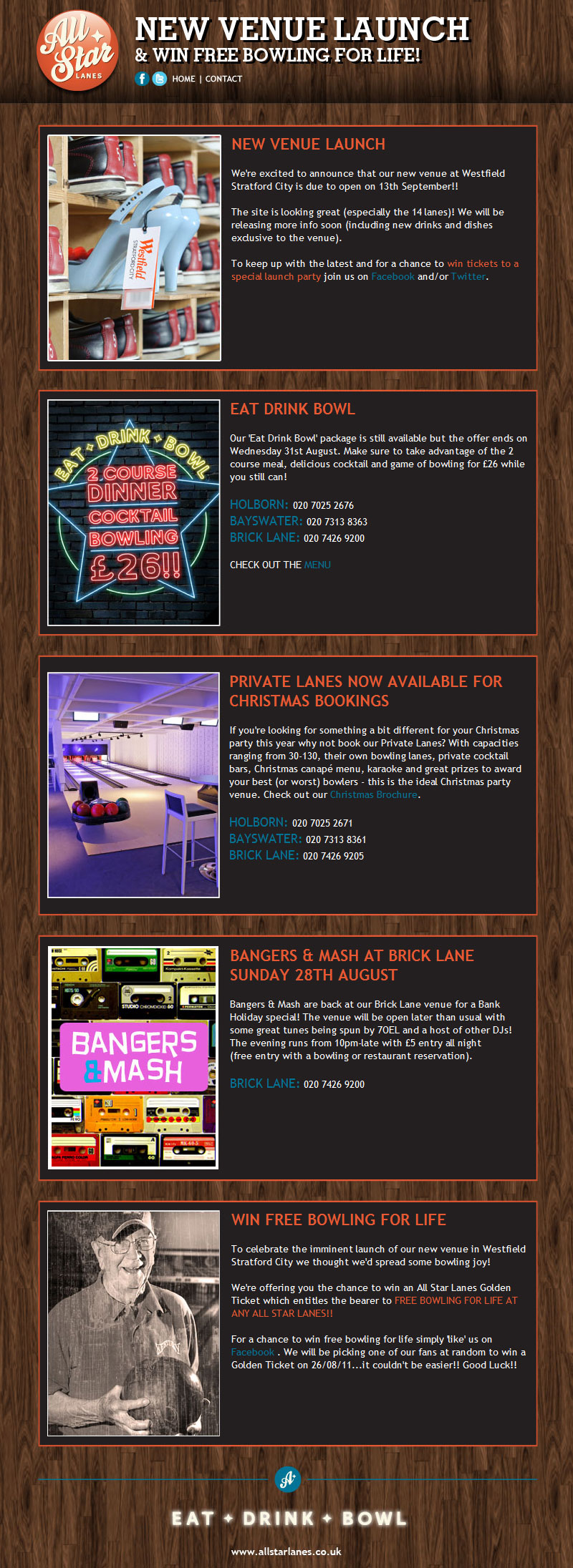
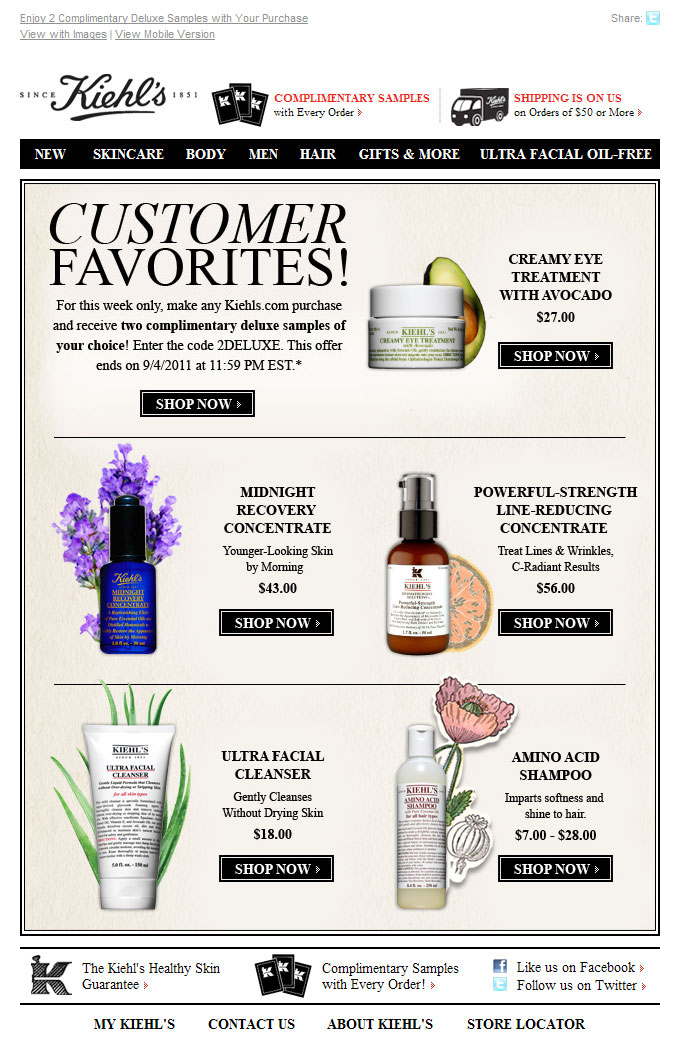
Email marketing can be a crucial tool for small businesses but it can be tough to see the results that you want.  No marketing campaign will have an open rate of 100%, however it also doesn’t mean that you should settle for single digit views for your campaign.

Categories
Customer Relations Marketing Public Relations

Gaming The System (Don’t Do It!)

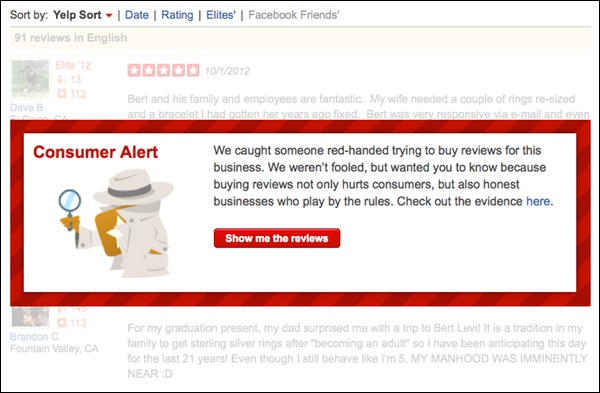
A little while ago Yelp announced that they are now showing “Consumer Alert” warning messages on the profile pages businesses that it says it caught trying to buy reviews.

As the New York Times reported back in October, Yelp conducted a sting operation in which one of its employees pretended to be an “Elite” reviewer and responded to review solicitations on Craigslist. As the article explains:

A pest control company offered $5 to anyone who would post a review that the business itself had written. The moving company was willing to pay $50 but wanted original copy. An appliance repair shop provided a start: “I really appreciate that the service tech was on time, the problem was solved, everything was cleaned up and he was very professional. Please add 50 or more words,” the shop suggested. It would pay $30.

The highest payment was offered by a jewelry store in San Diego, which said they was forced to solicit reviews after others got away with doing it. “We have noticed that some of our larger, corporate run competitors have been unfairly trying to get reviews written for them on Yelp, which puts us at a disadvantage,” wrote Bert Levi of Levi Family Jewelers. He said he would pay $200 for a review of a new custom-designed ring.

This warning is now showing — and will remain for three months — on the Levi Family Jewelers profile page on Yelp, and on the pages of other businesses that Yelp says it caught trying to buy reviews:

Unfortunately this is a result of how competitive the reviews space is right now and how desperate business owners are to get positive reviews. The problem is perhaps worse on Yelp due its review filter, which can be very hit and miss when it comes to choosing reviews to show or hide. This is certainly not a problem that only Yelp faces, as business owners can buy reviews for Google+, Amazon, app stores from various sites often for very little money.

Eric Singley, Yelp’s VP of Consumer and Mobile Products, tells the Times that the group of eight businesses that were outed in October “is just a sample” of businesses that are soliciting reviews. Hopefully Yelp and other review sites can continue to improve their algorithms to so to filter out the fake reviews and prevent the gaming of the reviews.

Here’s a tip on how to get customers to leave reviews on your Yelp or Google+ pages.


Categories
Customer Relations Marketing Social Media

Understanding Your Fans and Followers


Understanding Your Fans and Followers

For any conversation to be a success, you need some understanding of the people taking part. In social media, the majority of conversation will be driven by a group of fans who are more engaged than others.

There’s always a group of individuals who tend to post, comment, question, and share more than the rest. Whether it’s on Facebook, Twitter, Google+, these fans are valuable and important for the health of your conversations and your brand’s community.

So what is it about these highly engaged fans you need to understand? The common factor for this group is that they all like to contribute. Look a bit deeper and you’ll realize that they respond and interact in different ways, depending on the context and their own social motivations. It’s these motivations, rather than demographics, that are the real story.

Since social motivations are complex and can overlap we will look at seven behavioral characteristics typical of the most engaged fans.  Use these seven dimensions to guide interactions with your most valuable fans, and you’ll have richer conversations that will be more rewarding for all involved.
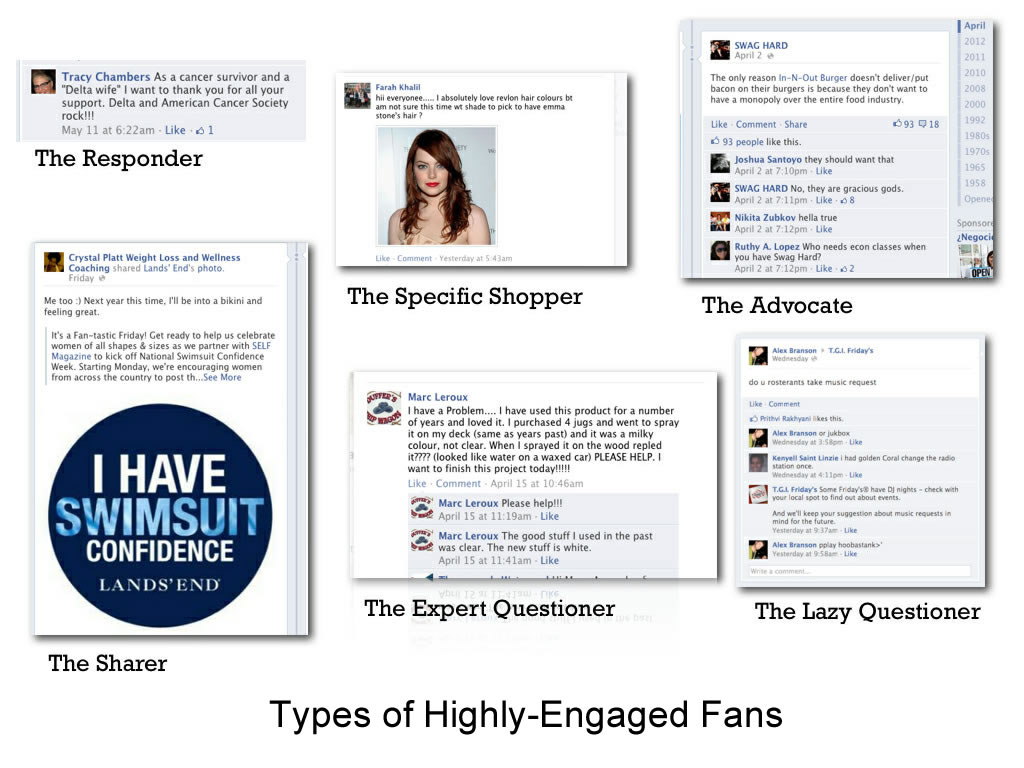
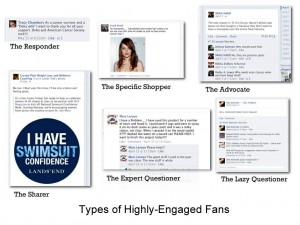
The Responder – Count on these fans to answer a question, enter a competition, like your posts and generally follow your direction. These fans may need prompting but they will be there for you on a rainy day and will keep your overall levels of engagement up. Create regular opportunities for these fans to participate with straightforward instructions and thank them when they do so.


The Sharer
 – Extending the reach of your conversations, these fans love to redistribute social content to their networks. Think of Sharers as part of your social distribution network. It’s important to make it easy for them to do what they do best: retweet, reblog, repost or sometimes remix.

They may have a sizable or influential network of their own, so make an effort to understand the secondary audience, and consider providing them with exclusive content. If appropriate, look for ways to reward Sharers by involving them in the creation or curation process. Monitor what they share and how they share it to learn what works best. Beware that negative content can be shared just as easily.

The Expert Questioner  These fans like to demonstrate how much they already know by asking questions. They might be asking obscure technical questions, or how a specific component compares to the special edition model from two years ago. What they really want is a chance to show off their encyclopedic knowledge of your product line. Encourage these fans to help answer other questions from the less informed. Or go further and reward them by inviting them to visit your company or letting them come to a special event. Their deep expertise could help craft subtle improvements in your products.

The Lazy Questioner – In some ways the opposite of the Expert Questioner, these fans ask the most basic (and sometimes irrelevant) questions, whilst making no effort to discover the answer. The Lazy Questioner hasn’t bothered to take a few seconds to do a Google search, let alone visit your website or read previous comments. They love your product or brand but they also love it when you serve the answers up to them. Demonstrate great customer service and create links to your product info that will be visible to others by answering them promptly. It’s also an opportunity to defer to the knowledge of your Experts, who will relish the status you have bestowed on them.

The Specific Shopper – Another type of Questioner, these fans want to get involved in a conversation about specifics. Does it come in another shade of blue? Can it be gift-wrapped and shipped to Australia? What accessories are compatible? These actively engaged people want to know the detail, either to get a product or service that’s just right for them, or because they are investing a lot of emotional energy in your brand. They may have deep knowledge of your category, or be a novice, so try to find out their level of expertise if you can. Then show the community how much you care about your fans by giving them the detail they need. They may buy one for themselves as well as their friend in Australia.
 

The Advocate – Over time and with the right treatment, the fans above may evolve into the most important members of your community. Advocates may talk about you unprompted, upload photos of themselves with your products, or privately give you feedback about that time you could have done better. They may be so engaged in the conversation they invite their friends to join in, and will share your excitement when you launch something new or have exciting news. They may also appear out of nowhere to defend you against criticism – especially valuable in times of crisis. The ultimate advocates generate positive conversation by encouraging others to try your products or services.

The Critics

Finally, remember that some of the most engaged people may be your critics, which is not necessarily a bad thing. These ‘Constant Critics’ may well be using your products and services already, and can offer valuable insight into where the pain points for certain types of customer are located. By listening carefully and treating them with respect, you may turn your critics into Advocates.

Categories
Web Tools

Tools for Small Businesses

In keeping up with the latest trends in marketing and the web, we often discover applications that have a lot of potential for a small company.  Here are a few of the interesting apps and websites that we have come across.  We encourage you to check them out.


Get Smart Content – This application allows you to set rules such as, “visited our website five times” or “from Connecticut” and show different content based on the visitor is coming to your site.

Napkin Labs – Cool little Boulder CO company making apps that provide more Facebook engagement.

PDFtoHTML – This converter allows you to convert any PDF document into an HTML page.

Boun.cr – This is an interesting startup that offers email shortening, kind of like bit.ly, but for email.  It allows you to share your short address publicly without the worry of spam.

OneLoad – This website offers you a simplified way to distribute video to multiple sites. Definitely a time saver if you upload videos to multiple sites.


Categories
Email Marketing

Emails that every small business should think of sending

Whether you’re just starting out with email marketing or you already have some experience sending marketing emails, you’ve probably wondered about the types of email communication you should send to your customers.

Should you nurture your subscribers with weekly newsletters? Are dedicated emails better at optimizing your sales and marketing goals?  Should you send emails with highlights of news and your best content from the past month or quarter?  These are all valid questions that a small business should consider when selecting the right format to meet their marketing goals.
email type 1

If you decide to use a newsletter strategy you must decide on what your trying to achieve.  Are you trying to nurture you current clients and contacts so they think of your brand first when they need the product or service in your industry?  Or is your goal to attract new contacts through social sharing?

email newsletterEmail newsletters have two key advantages. First, they can spread your brand awareness. By building continual communication with your email subscribers, you enable them to recognize your brand and keep them aware of your products and services.  Second, email newsletters give you the freedom to include different types of content that might be important to your organization while leveraging content you have already created. For instance, a newsletter can contain a popular blog post, a new offer, highlight products, an announcement of an upcoming event, information about a discount, or a company video on Youtube.

There are some disadvantages to using an email newsletter. First, they dilute the main call-to-action. If you include a series of blurbs or article summaries, the attention of your recipients will most likely be spread across these tidbits of information as opposed to staying focused on a certain element. Second, the design of a newsletter becomes much more time consuming as you’ll have to spend some time deciding on the right placement of images and text, alignment, and prioritization of information.

email type 2

digestA digest is similar to newsletters, it provides a summary of existing information and offers a snapshot of a specific time frame (the time span of a week or a month). Traditionally, digests highlight the most popular pieces of content that new readers will gravitate towards.  Companies that have a very active blog use this strategy to bring repeat traffic to their site.

A digest really only works if you are creating a substantial amount of content for users.  Some businesses purchase relevant content from companies that churn out articles and use the articles to post on blogs and for use in digest emails.  While this can be a useful strategy, quality tends to be lower, which for some customers can be a turn off.

If you were a small bookstore and did a lot of reviews, you might set up a digest email where your customers could select to receive only emails that highlight reviews on murder mysteries.  If you don’t create a lot of content on your website, it might be more beneficial to go with a newsletter style email.


email type 3


Dedicated emails, also known as stand-alone emails, contain information about just one offer. For instance, you can use a dedicated email to notify your target audience about a new service or a sale that your business is having.  Personally, I always look forward to receiving Eurostar’s dedicated email.

dedicated sendDedicated emails have three main advantages. First, they help you set up the context to introduce a main call-to-action and focus on that one offer. Second, creating a dedicated email tends to be easier than creating a newsletter email. Unlike newsletters, stand alone emails don’t need to include multiple graphics to separate the different blocks of text and prioritize information. Third, they are easier to measure. When you promote one main message and call-to-action, you can track the results of the email with greater accuracy as the message will be focused on one call-to action.

Dedicated email also have some disadvantages. First, with stand alone emails, the emailing schedule is less clear and potentially less consistent. You might use dedicated emails when you have published a new offer (and for a small business, this tends to be sporadic). Even if you decide to maintain a specific schedule, your subscribers might not realize it or expect communication from you because there is no clear connection between the separate emails. Second, it’s tough to include diverse content in a dedicated email, so you cannot add other calls-to-action that might also be important to your organization.


The important point to remember is that whichever format you choose, you want to create engaging content for your consumers. Make sure that you understand your email list and what they are looking for.  If you don’t take the time to deliver an email that connects with your customers, those emails will end up in the spam filter.


Categories
Customer Relations Public Relations Social Media

PR Nightmare


A company’s image is one of the most valuable assets that they own.  Should anything happen to that image, companies can quickly discover that everything they have worked hard to achieve over the years evaporates in front of their eyes in a matter of days.

In this day of Email, Facebook, and Twitter, bad customer service can quickly spread throughout networks.  Take the example of Papa Johns, a well known chain of pizza restaurants.   During the first week of January, a customer named Minhee Cho was described on her receipt by an ethnic slur. She posted the image of the receipt to her Twitter page on Friday, by Sunday it had over 200,000 views.

On Saturday, Papa Johns issued an apology via their Facebook page.  To put into context the scale of bad publicity, there were over 4,500 mentions on their Twitter handle (@PapaJohns) on Saturday verses their normal 50-80 a day).  Their fast response and quick termination of the employee who was responsible for the slur should help minimize the damage, yet even a few weeks later, the incident still showed up on the first page of Google’s search results.

Another recent case of a PR disaster is the case of the N-Control, an after-market controller for the Sony Playstation 3.  The email conversation between the customer inquiring about the status of a controller that he had purchased a month earlier and the third party marketing contractor is jaw-dropping.  In this case, the disaster nearly destroyed the company before it got its brand new product out.

This goes to show how no matter how much you put into your product and the marketing, if you’re not backing it up with trained employees and outstanding customer service, it can all be for nothing.  If a customer has a bad experience, they are likely to tell 9 people over the course of a day.  In this age of social media, mobile apps, texting, etc., a post of their bad experience online can be seen by thousands in minutes.  That’s the power of the internet.

So how does a small company prevent this?  Whether you do everything in house, or hire a company/outside consultant, make sure there are clear guidelines and escalation channels.  Create an atmosphere where if there was a confrontation/mis-understanding/mistake that it can be brought to the attention to decision-makers and quickly resolved.  Ignoring the problem won’t help, it’s best to tackle it.

Also it is important that you have channels to get your message out.  Make use of your email lists, social media, and your website.  Keep an eye on your online presence.  Check in on review sites (Yelp, Angies List, Google Places, etc) , respond to criticisms in a responsible way.  Remember, it just takes one customer with a bad experience to cancel out hundreds of customers with good experiences.


Categories
Branding Marketing

Telling Your Story

What is the best way to tell a story about your business?  In today’s world there are many methods for getting your message out, but how do you tie it all together?

In the below ad by Google, you can see their ecosystem is truly built to help businesses from soup to nuts. Even with Google+ being a question mark, it’s hard to see a business thinking that they should only invest in posting status updates on Facebook or Twitter.

Too often companies miss great opportunities to create excitement for products and services by not taking full advantage of the web.  This doesn’t mean that a company should be sending out loads of twitter messages and doing weekly Google+ Hangouts.

For example, take a bike shop.  Maybe you have a long time customer who just got that dream bike. Take a photo of them just getting the bike and include it in your next newsletter (or post it on your Google Places/Bing Local page).  By highlighting both the long time bond with the customer and the quality of the product you sell you will be creating a story about your company and what it means to be a customer at your store.

Telling the story about your business doesn’t need to be time consuming, but by taking a little time every now and again, you can gain that edge over your competition.  So how do you tell your story?

Categories
Customer Relations Email Marketing Marketing

Timing Your Email Campaign

Reaching customers at the right time of the day can be the difference between getting your emails clicked and having them ignored. The only way to determining the optimal time to send to your customers is to test your campaigns.

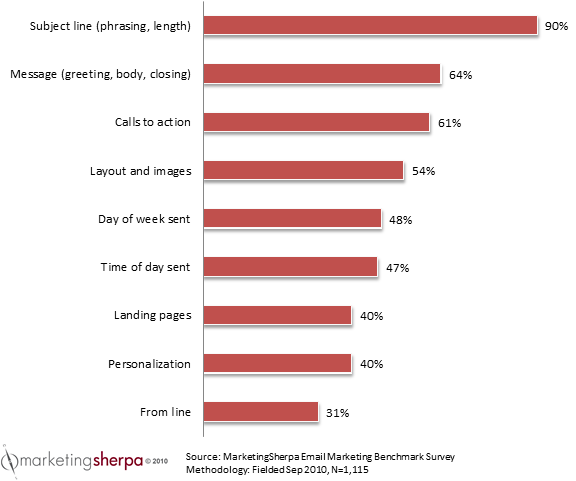
Email Campaign Elements Routinely Tested to Optimize Performance According to research from MarketingSherpa, if just 47% of marketers test when to send an email to their in-house lists, that means over half of all email campaigns are not considering if their emails might be opened, links clicked or better conversion rate by changing the time or day of the week it is sent.

Many companies use the commonly accepted time of 11 am Eastern Standard Time to send emails.  This is probably not ideal if you’re trying to generate leads, simply because many other email campaigns are also targeting this timeslot, cluttering the inboxes of the targeted recipients. The only way to know when is the best time of day to send your emails is to do some testing of your own.

Since every target audience is unique, optimizing your email strategy depends on the understanding the behaviors of your specific audience.  In your testing, consider trying out times you wouldn’t think are optimal for emails.  Record the data that you gain to build a record of your results. While finding the best time to send your email is an important part of delivering a successful email campaign, you will also want to test subject line, message, images, and layouts to maximize your results.  When you find a time that increases email open rate, link click through, or conversions, make sure to still occasionally test the timing.  Your email list changes over time so it is important to keep searching for the optimal time to reach your customers.
Categories
Branding Websites

How To Get The Most From Your Homepage

There is a saying, never judge a book by its cover.  Unfortunately, we all judge by the cover.  In regards to the web, your homepage is your “book cover”.  If you are a small business, your “book cover” is just as important as a store front or a business card. Here are some tips to get the most out of your homepage.


Keep It Simple

Don’t try to be like a large company’s website.  They’ve conditioned their repeat users to know how to navigate through their widgets, thumbnails and menus.  Think back to the first time you went to Amazon or Ebay, it took several minutes to find what you were looking for.  With those companies, even if you didn’t find what you were looking for on your first try, you most likely will give them a shot again since their brand is so well known. Small businesses don’t have that luxury.  Often you get only one chance to get a customer.  So keep it simple and communicate your product or service with a stand out image.  You don’t want to confuse your potential customers with excess clutter.


Be conservative with the scroll

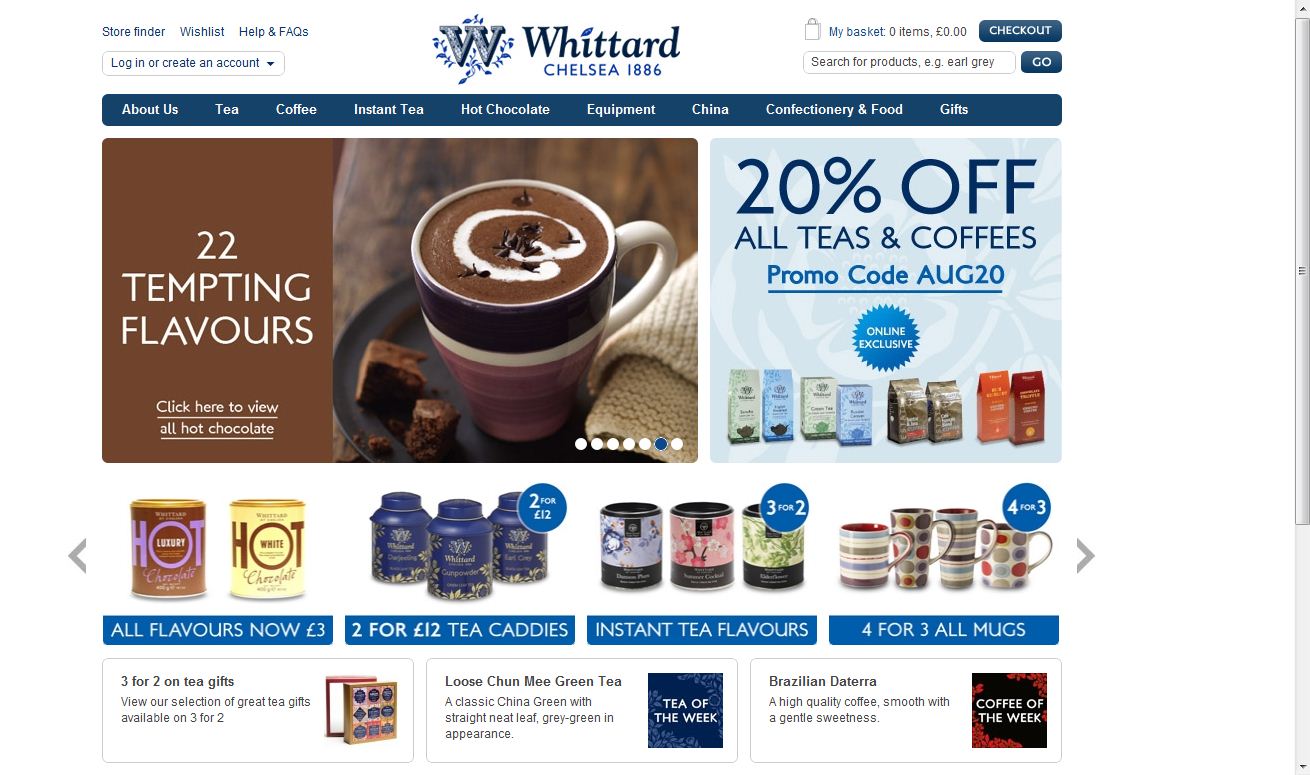
If you are highlighting products you sell on your home page, limit the number that you present.  You don’t know what type of computer or mobile device your customer is using.  If there is a lot of information on the home page it can lead to a very slow load time for them.  As you can see with Whittard Chelsea home page, when you land on the homepage you see most of whole page.

Link to categories or sections where you can present your products.  If you want to highlight specials or create opportunities for product promotion, avoid making it look like a large restaurant menu.  Instead, think of highlighting a select few items and create an image to promote it.


Display the right links

If you keep your home page simple make sure that you are displaying the links that your customer wants.  Generally you should have an About, Product, New or Blog, and Contact (unless you are having very easy to see contact info on all your pages).  It is important that visitors can discover what your business is about and how they can participate. Keeping your mobile site in mind is important.  Since users who visit via phone will not be engaging in prolonged browsing, you want to get them to the correct content as quickly as possible.  It is important to keep an eye on your analytics to see what type of device your website is being viewed on.  If you are noticing that more mobile devices are starting to view your site, you need to adjust to make their browsing experience better.


Keep Featured Products Above The Fold

Display products you’re proud of or photographs that pop off the screen.  It boils down to curb appeal, when you walk down a street full of clothing and art stores, they don’t display last year’s discounted trends, but their best products.  So highlight your best products and entice them to act.  This doesn’t mean that you can’t still highlight discounted products as mentioned in the second point, but just make sure it will draw in your customers.


Make It Current

Some businesses want to promote their social media outlets in other ways than widgets.  If your business is active on Twitter or Facebook you are able to offer a live feed on your home page.   Seeing social media updates on the home page is a way of creating excitement for your company. If you chose to highlight Twitter, then you must stay active on there.  If your last tweet was a month ago, it will reflect poorly on your company and customers won’t stick around.


Consistency

Select a design, template, color and logo very carefully.  You will want these elements to reflect your product and services across multiple platforms.  By having consistency both in the virtual and physical world you will increase your brand awareness.

Attach a featured image to your Homepage and pages

In the age of social media, sharing links is a normal occurrence.  I have noticed often when I go to share a link, the image thumbnail does not match the article.  You don’t want to be linking to a serious article and have a thumbnail a random image showing up next to the link.  Without a thumbnail, the link click through rate drops substantially. If your company does an abstract service it can sometimes be hard to come up with a feature image, therefore, use your logo or an avatar.


Please share links to your innovative homepages in the comments below.

Categories
Blogs Customer Relations

Three Ways to Get Great Content Even If Your Business Isn’t Exciting

A company’s blog is a golden opportunity to share two things: how much you know about your industry and insight into your personality.  So it can be frustrating for small business owners to hear that they must start up blogs and have social media if they are in a B2B industry or any other industry that may be less exciting than consumer technology, fashion, sports, or entertainment. Everyone wants to focus on creating the right content — content that will attract positive attention, better SEO and social media viral goodness. But what if you’re selling network cables? Dumpster covers? Toilet seats? Auto Repair? What do you have to work with?

Plenty.

Solve a Problem

Get back to basics — you’re probably in business because your product solves a problem, or makes something else better. Write about the challenges and solutions that will benefit your potential customers — not just the problems and solutions that involve your product, but the other unique challenges your customers face with everything from supply chain management, logistics, global networking, web conferencing solutions, etc. This is what is meant by becoming a resource. Yes, it will take work, but there should be plenty to keep you juiced up creatively, get your foot in the door with prospects and retain your most valuable customers.

Be Relevant, Get Creative

If you’re only focused on your own product or service, you will have a relevance problem.  While focusing on the little details of your product or services may be interesting to those who devote their day to day activities to this, the average consumer couldn’t care less.

Work on tying your product or services to current trends and topics that are currently prevalent in the media.  By connecting the dots between what the world cares about and what your business cares about, your customers will see that your company is not dull.

For example, let us say that you own a plumbing or hardware store, you may want to highlight some of your products that were featured on a recent home remodeling show.  By tying in the TV show your content is now more engaging and relevant.

Be the Media

Not mass media, of course, but your own little hyper-niche, hyper-focused version of the media. Publish on your blog or Facebook interviews with industry leaders, government regulators and experts that your potential customers look to for guidance.

Another tactic would be reviewing products.  While you will look at products that you sell favorably, you might want to review items that you don’t sell that your products interact with.

Let us know what has worked for you.